AI tools
On creative workflows, artificial intelligence, and the things only humans can do


On creative workflows, artificial intelligence, and the things only humans can do
Everyone in the creative industry is talking about AI. Most of the conversation falls into one of two camps: the people who think it's going to take every creative job by Tuesday, and the people who refuse to touch it because it feels like cheating.
I'm in neither camp.
I've spent the last two years integrating AI deeply into my creative workflow — not as a novelty, not out of fear, but because I've always believed the best creative leaders are the ones who master their tools before anyone else does. That's what I did with Sketch. With Figma. And now with AI.
Here's what's actually changed. And what hasn't.
The speed of strategy.
The part of brand work that used to take the longest wasn't the design — it was the thinking that had to happen before the design. Competitive audits. Positioning frameworks. Messaging architecture. Creative briefs. These are still human-led activities, but Claude has become my thinking partner in a way that's hard to overstate.
I use it to pressure-test strategy, stress-test copy, and get to a strong first draft faster than I ever could alone. The output still needs my judgment, my experience, and my editorial eye. But the blank page problem? Largely gone.
Image generation as a starting point.
Adobe Firefly and Mid-Journey changed how I approach concepting. I can now generate a mood direction, a visual metaphor, a rough composite — in minutes — and use that to get stakeholder alignment before a single production dollar is spent. That's not replacing photography. It's replacing the three rounds of back-and-forth that used to happen before anyone knew what they actually wanted.
The photoshoots still happen. I've directed five for GE alone. Original photography still matters enormously. But now I show up to those conversations with a clearer visual brief and a client who already said yes.
UI ideation at the speed of thought.
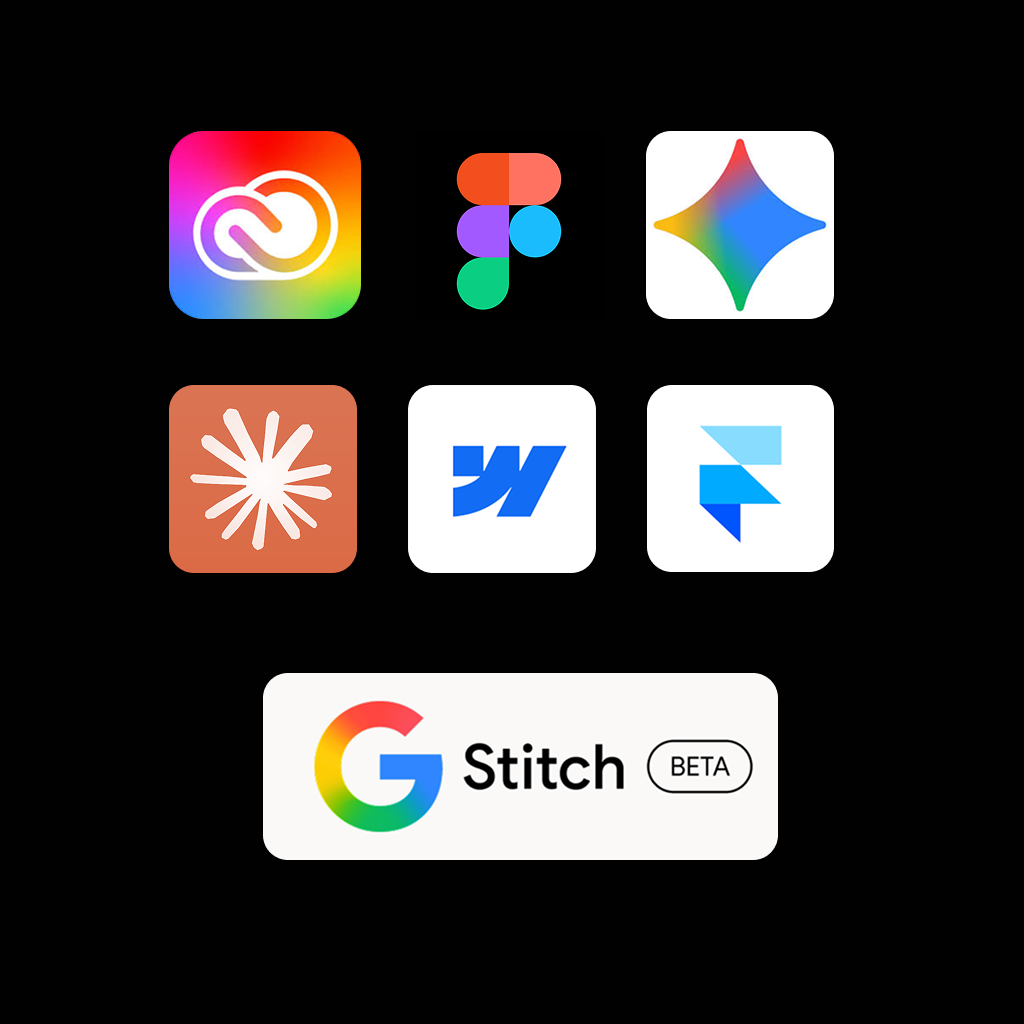
Google's Stitch is the newest addition to my stack and it's already changing how I approach web projects. Upload a screenshot, a sketch, a rough direction — and you have a working UI layout to react to. Not final. Not perfect. But real enough to have a real conversation. Moving fluidly between Stitch, Figma, Claude, and Webflow or Framer, I can go from concept to deployed page faster than most teams can schedule their first kickoff.
AI inside Figma itself.
The AI features building into Figma — auto-generation, design suggestions, content population — are still maturing, but the direction is clear. Design systems are going to get smarter. Repetitive production work is going to shrink. The designer's time will shift further toward decisions and further away from execution.
That's not a threat. That's leverage.
This is the part I feel strongly about. And I want to be direct, because I think a lot of the conversation here is either dismissive or naive.
It cannot replace creative judgment.
AI generates options. It does not know which option is right. That call — the one that factors in brand equity, audience psychology, competitive landscape, business stage, and the gut feeling that comes from decades of pattern recognition — that's still a human call. Specifically, it's the call of a senior creative who has made it a thousand times before.
Every AI output I work with gets filtered through 20 years of knowing what works, what a client will actually approve, what will land with a B2B buyer who has 30 seconds and six other tabs open. That filter is not something you can prompt.
It cannot build a relationship.
The best creative work I've ever been part of happened because of trust — between me and a CMO, between a brand team and its agency, between a designer and a developer who had worked together long enough to read each other. AI doesn't build that. It doesn't read the room in a stakeholder presentation. It doesn't know when to push back and when to let something go. It doesn't remember that this particular client hates blue.
Client relationships, team leadership, cross-functional influence — these are creative skills too. They just don't show up in a prompt.
It cannot take creative responsibility.
When a rebrand lands, someone made the call. When a campaign converts, someone had the vision. When a design system holds together across 47 touchpoints, someone built the architecture. AI can assist all of those things. It cannot own any of them.
Ownership — creative accountability, the willingness to put your name and your reputation on the work — that's still entirely human.
It cannot feel the thing it's making you feel.
This one is harder to articulate but I think it might be the most important. The best creative work doesn't just communicate. It resonates. It creates a moment of recognition, or surprise, or warmth. It makes a B2B buyer feel seen.
AI has no experience of being human. It has processed an extraordinary amount of human output, and it can produce work that mimics resonance. But the original impulse — the observation, the empathy, the specific human moment you're trying to capture — that still starts with a person.
What This Means If You're Hiring
If you're looking for a Creative Director or brand strategist right now, here's what AI proficiency should actually tell you about a candidate: it tells you they're not afraid of change, that they invest in their own evolution, and that they're thinking about efficiency and output alongside quality.
What it should not tell you is that the human in the equation matters less. If anything, the opposite is true. As AI handles more of the production layer, the strategic and creative judgment at the top of the process becomes more valuable, not less.
The question isn't whether your next creative leader uses AI. They should, and if they don't, that's a red flag.
The question is whether they know what to do with it — and what to do when it runs out of answers.
Elisa Ivany is a Creative Director and Brand Strategist based in Chicago, with 20+ years building brands across B2B SaaS, fintech, and healthcare. She builds in Figma, thinks in Claude, and is currently exploring everything Stitch can do.